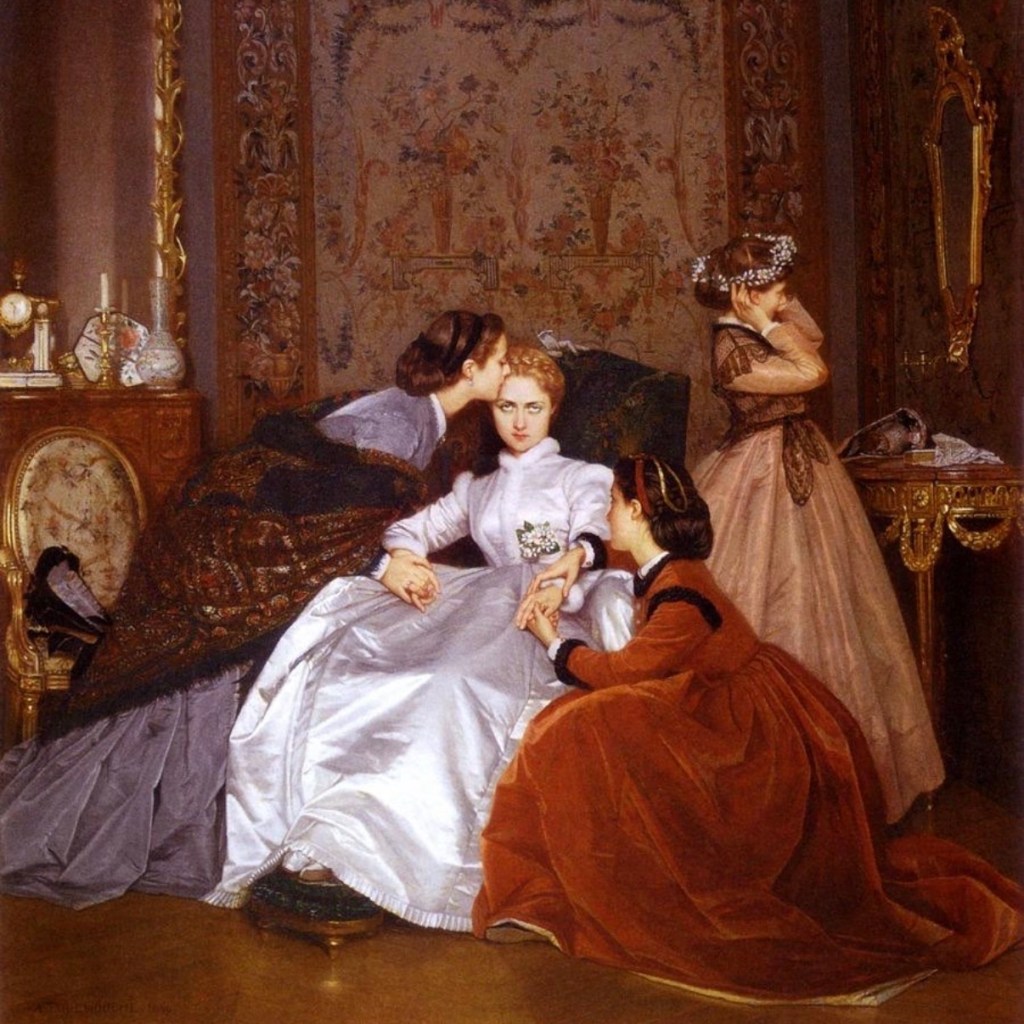
Toulmouche, A. (1866). The reluctant bride
As a brown woman, it is almost comical that the sudden wedding boom among my peers managed to catch me off guard when I turned twenty five. Marriage for women around this age had been presented to me as something close to an inevitability since I was five, and yet, somehow, I still wasn’t prepared.
Not everyone, obviously. But enough people that opening Instagram has begun to feel vaguely ceremonial. Women I remember talking to about exams, career plans, and the generally questionable nature of men are now comparing venues, photographers, and wedding dates. Somewhere between those conversations and these ones, we apparently crossed an invisible threshold and became old enough to have husbands.
My own family is surprisingly progressive about it. I haven’t been handed a deadline. Nobody is circulating my photograph through WhatsApp groups or sliding into DMs with biodatas. Most women in my family tend to get married closer to twenty eight. That, we joke, is the “magic age.”
Whether it is magic or a curse seems to vary from person to person.
And yet, even without the sword of impending marriage dangling over my head, the subject has managed to occupy far more space in my thoughts than my current circumstances reasonably warrant.
I have been observing marriages.
In the context of our culture, I have divided them into four categories. Really, they are just different permutations of two possible scenarios, arranged or love marriage, happy or unhappy.
Arranged and happy. Love and happy. Arranged and unhappy. Love and unhappy.
I have seen every kind within my vicinity. Anecdotally, the latter two seem far more common than the first two.
This is an admittedly terrible sample size, but it has given me one useful conclusion.
I have absolutely no idea what makes a marriage work.
Neither, I have begun to suspect, does anyone else.
That uncertainty may be why I have never been able to think of marriage as a goal.
I have lots of goals. Career goals, personal goals, emotional goals. If I want to become better at something, there is usually something I can do about it. Read more. Practice more. Work harder. Learn what I don’t know. Fail, figure out why, and try again.
There is something reassuring about effort increasing your probability of success.
Relationships have the deeply inconvenient feature of involving another human being.
I can become the most emotionally intelligent, financially independent, interesting, well read, kind, communicative version of myself. At the end of all that self improvement, someone still has every right to look at me and think, No, thank you.
There is no amount of personal development that can remove another person’s right not to want me.
And attraction isn’t nearly as politically correct as we sometimes want it to be. People reject people because of money, weight, height, faces, bodies, careers, personalities, class, race, religion, education, and a thousand other things ranging from profound to embarrassingly superficial. Some of those preferences are obviously shaped by the social conditioning of a flawed system. We can examine them and question them. But examination and attraction are not the same thing. You can interrogate why you have a certain preference without being able to argue yourself out of it.
More importantly, I cannot argue someone into liking me.
I don’t want to.
If someone doesn’t want me because I don’t look the way they want their partner to look, I would rather they reject me than date me as an act of political correctness. I don’t need anyone to overcome themselves in order to tolerate me. And I would rather be alone than be someone’s version of “settling down,” chosen because they have accepted that they probably won’t get the person they actually want.
Maybe that sounds pessimistic.
Marriage sometimes makes me pessimistic.
Not marriage itself, exactly. I am neither pro marriage nor anti marriage. As a brown woman, I have a rather difficult relationship with the idea of marriage, or, I suppose, with the idea of love. As the bio of this blog says, I identify deeply with Jo March from Little Women, particularly with her monologue in the 2019 adaptation.
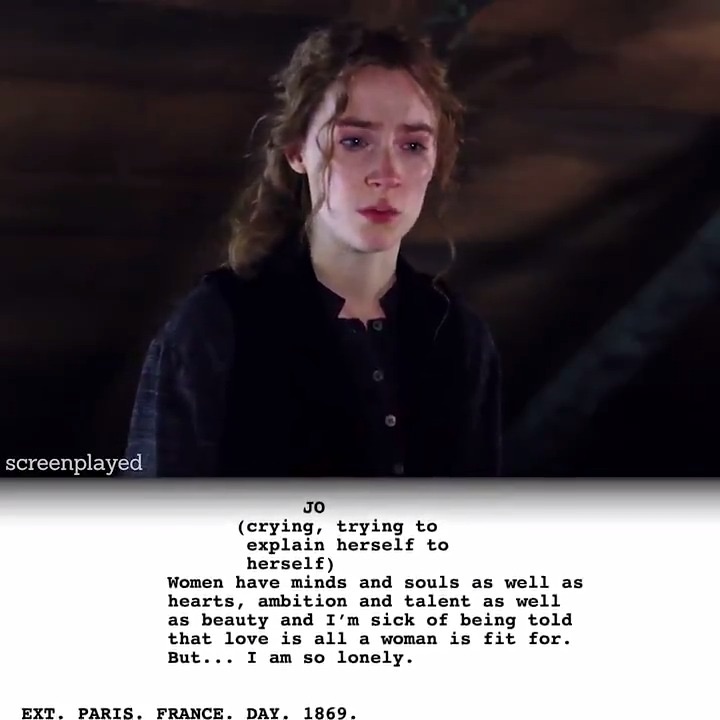
We are conditioned from such a young age to think of marriage as an inevitability rather than a possibility. It is presented less as one path a woman might freely choose and more as the natural conclusion toward which her life is expected to move. When the expectation precedes our ability to choose it, it becomes difficult to know where conditioning ends and desire begins.
I resent that conditioning, even though I do not necessarily resent the institution itself.
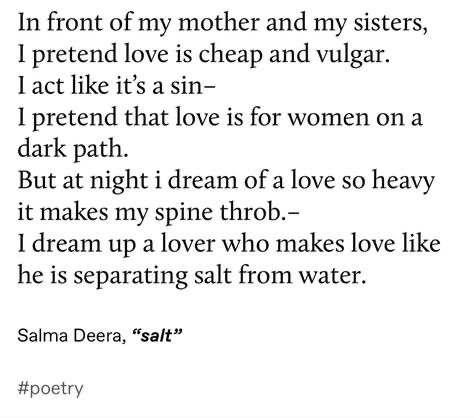
And perhaps that is where my discomfort really lies. Once we have fought against being told that we must want something, it can feel almost like a betrayal to discover that we might want some version of it anyway. Wanting marriage, romantic love, a life with another person can suddenly feel embarrassingly conventional, as though freely choosing what women before us were compelled to choose somehow means surrendering the freedom they fought for.
That contradiction is perhaps better articulated in the opening stanza of Salma Deera’s “Salt.”
Maybe the problem is expecting marriage to carry a fixed moral meaning at all. Marriage seems to me like an extremely human arrangement, which means it can contain almost everything humans are capable of, tenderness, loyalty, boredom, selfishness, sacrifice, cruelty, friendship, resentment, sex, companionship, compromise, convenience, love.
And people marry for all kinds of reasons. I am not that naively young to still believe marriage is always the ending sequence to ab elaborate love story.
People marry for love, financial security, children, family, religion, companionship.
They marry because they are lonely.
I don’t think that makes those marriages inherently lesser.
But however justified those reasons may be, most of them, if not all, simply aren’t mine.
Perhaps that has something to do with the fact that I was an only child. Independence was something I looked forward to from a strangely young age. I wanted my own decisions, my own money, my own space, my own life.
Being alone has never automatically felt like something has gone wrong.
I get lonely.
Of course I do.
There are nights when I wish somebody were there. There are moments when everyone seems busy with lives that increasingly include partners and families, and I become acutely aware that I am going home alone.
But loneliness comes to me in waves.
Solitude is what remains when the wave passes.
And I like the solitude.
It has also given me one of the greatest privileges of my adult life. Knowing myself.
Not completely. Twenty five would be an obnoxiously early age to announce that I have solved my own psyche. But I know what I like. I know how I like spending a Sunday. I know what kind of work matters to me. What my ideologies are, where I stand politically. I know what I want my life to feel like. I know which things I can compromise on and which compromises slowly turn me into someone I don’t like.
And once you know those things, other people’s relationships become surprisingly difficult to envy.
I can look at a relationship that is perfectly happy and think, That would make me miserable.
This has made Instagram considerably less powerful.
I can think the bouquets, vacations, anniversary dinners, and surprise gifts are cute without mentally inserting myself into them.
Because I don’t want a relationship as a concept anymore.
I want a very particular kind of relationship.
For example, I don’t want a provider.
I understand why someone else might. I don’t think wanting a traditional relationship makes a woman stupid, insufficiently feminist, or secretly oppressed. If that arrangement makes two people happy, I have no interest in explaining their own happiness to them.
But I also don’t want to look at another woman’s happiness and gaslight myself into believing it must secretly be what I want too, simply because I am a woman.
It isn’t.
I want something much closer to an egalitarian partnership.
I want two capable adults who know how to exist without each other and decide they would rather exist together.
Maybe this is not romantic enough. At least in the traditional sense.
But the older I get, the more romantic I find the idea of being completely unnecessary to someone and still being chosen.
I want someone who could leave and survive.
I want to know I could too.
And then I want us both to stay.
I want calm kind of love.
I want the kind of trust I have in my closest friendships, where affection isn’t measured by anxiety. I want somebody who feels less like an emotional roller coaster and more like coming home, putting on the mood lights, making a cup of tea, and curling up on the couch with your favorite book. A story you know from cover to cover, yet still want to read all over again.
I once read something in a romance novel that has, funnily enough, become one of my few personal mantras for romance.
“You should have enough similarities to keep things comfortable and enough differences to keep things interesting.”
I don’t want someone to transform my life beyond recognition.
I rather like my life.
I want someone who can enter it without requiring its complete transformation.
Of course, a real partnership would change things. People aren’t decorative towels. People get sick. Careers move. Parents age. Money becomes complicated. Love creates obligations because another person’s wellbeing starts mattering to you.
Complete independence inside a marriage is probably another fantasy.
But there is a difference between interdependence that grows from love and dependence that becomes the reason you cannot leave.
I want the first.
And if I can’t find it?
That is the part I have been thinking about at twenty five.
Because somewhere beneath all the weddings and questions and cultural timelines is a threat that women absorb remarkably early.
What if you end up alone?
It is almost always phrased as though the sentence has already answered itself.
Alone.
What could be worse?
There is supposed to be an age at which that possibility begins frightening me enough to negotiate. Perhaps I will loosen a standard here. Accept a dynamic there. Maybe eventually the prospect of an empty side of the bed is supposed to become scarier than sharing it with someone who disrupts the peace I had before him.
I keep waiting for that fear to arrive.
It hasn’t.
That doesn’t mean I have decided to be single forever. I haven’t sworn off marriage. I am not writing this from some enlightened mountaintop where I have transcended romantic attachment and now require only books and myself.
I would like to fall in love.
I would like a partner.
Someone funny and competent and calm. Someone with a life of his own. Someone I can talk to, travel with, sit silently beside, argue with safely, trust without monitoring, and grow old next to without either of us becoming the other’s entire reason for existing.
I just don’t know if I will meet him.
Maybe I will.
Maybe I won’t.
What does feel catastrophic is marrying someone for the sake of marriage and spending every day sitting outside my own door for ten minutes after work because going inside means being with the person I married.
Or being the person someone else sits outside the door to avoid.
All I can control is whether I build a life that remains worth living either way.
Which brings me back to the four marriages.
For a while, I thought the funeral in this story would have to be something dramatic. The death of romance. The death of my youth. The death of some imaginary biological clock, perhaps, although at twenty five that seems unnecessarily theatrical.
But I think I know what I am burying.
It is the fear.
The fear that solitude is merely loneliness that hasn’t become unbearable yet. The fear that other women finding partners means I am falling behind. The fear that happiness arriving in a form different from mine means I have misunderstood my own. The fear that if I am not sufficiently worried about marriage now, an older version of me will someday punish me for it.
Maybe she will disagree with me.
But I cannot make decisions for a hypothetical forty five year old woman by betraying the twenty five year old who actually exists.
Right now, I know what she wants.
Friendship. Equality. Attraction. Trust. Calm. To be able to breathe inside love.
And if that person never arrives, she would rather miss a person she never met than spend her life missing herself.
So here I am at twenty five, watching the marriages accumulate around me.
Some arranged. Some chosen. Some beautiful. Some cautionary. Some probably far more complicated than I will ever know.
I hope there is love somewhere in my future.
But I am no longer willing to confuse hoping for company with fearing my own.
Four marriages, then.
And a funeral for the idea that a woman alone must necessarily be a lonely one.

 thebrownjomarch
Leave a comment